Guides / Sourcing
MIL-T-21014 vs ASTM B777: How to Convert an Old Tungsten Heavy Alloy Callout
October 20, 2026 · Reviewed October 4, 2026

A drawing arrives with a material note that reads “tungsten alloy per MIL-T-21014, Class 3”. The drawing may be decades old. The part is a counterweight or a balance weight, and the buyer wants a quote. Before anyone orders material, someone has to work out what the callout means today.
This guide explains how the old military specification relates to ASTM B777, how the classes line up, what to verify and how to word the replacement callout. It is written for buyers and engineers dealing with legacy drawings for civil and industrial parts such as counterweights, ballast and shielding.
What the two documents are
MIL-T-21014 is a specification for tungsten base alloy made by pressing and sintering metal powders, issued under the US military standards system. It defined classes by composition and density and set minimum mechanical properties and test methods. Over time such military material specifications have been replaced by commercial standards, and for tungsten heavy alloy that replacement is ASTM B777, the Standard Specification for Tungsten Base, High-Density Metal.
Both documents cover the same family: sintered alloys with a high tungsten content, typically 90 to 97%, in a binder of nickel with iron or nickel with copper. Both define four classes, and both address density, tensile properties, hardness and workmanship. They differ in wording, in the exact limits and in the test and report requirements.
The current status of any government specification can change, so check an official source before relying on it. Do not assume that a drawing citing a document means the document is still active or that mills certify to it.
How the classes line up
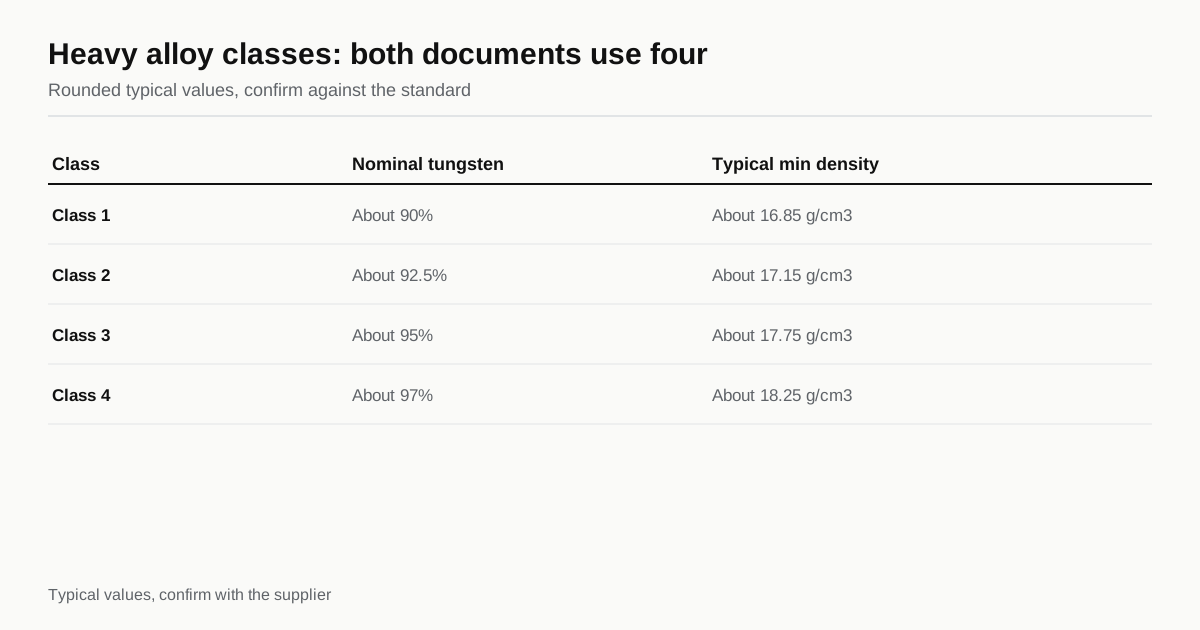
The four classes in both documents are defined by nominal tungsten content and minimum density. The table shows the usual mapping. Values are typical and rounded, so confirm each against the standard itself.
| Class | Nominal tungsten | Typical minimum density, g/cm³ | Typical use |
|---|---|---|---|
| 1 | About 90% | About 16.85 | Lower density counterweights, shielding, general use |
| 2 | About 92.5% | About 17.15 | Counterweights, balance weights |
| 3 | About 95% | About 17.75 | Higher density parts with machinability in mind |
| 4 | About 97% | About 18.25 | Maximum density in the limited space |
In practice a MIL-T-21014 Class 3 maps to ASTM B777 Class 3 for composition and density. The mapping is close but not a guarantee. Small differences in mechanical minimums, in how density is reported and in the required tests can change what a mill must do for the certificate.
What to check before converting
- Read both documents. Compare the class table, the mechanical properties and the test methods side by side, not from memory.
- Confirm the binder. Some old drawings assumed a nickel-iron binder, which is magnetic. If the application is magnetically sensitive, state the binder explicitly on the new drawing. See the non-magnetic tungsten guide.
- Check the mechanical minimums. If the part is load-bearing, compare tensile strength, yield and elongation requirements in the two documents and check that the new callout does not lower them.
- Check the density method. Density by Archimedes in water is typical, and the report should state it. The density test guide shows the method.
- Check approvals and customer requirements. If the part is on a controlled drawing, a change of specification may need a formal drawing revision or an approved deviation from the design owner.
- Check traceability needs. Some programmes require a certificate of conformance that names the exact document and revision. A mill certifying to ASTM B777 will not automatically also certify to the old specification.
- Check export-control status. If the drawing came from a government programme, ask your compliance contact whether the part or the drawing carries export restrictions before you send it to suppliers.
Writing the replacement callout
A clear callout avoids guesses. A workable example is: “Tungsten heavy alloy per ASTM B777, Class 3, nickel-iron binder, density 17.75 g/cm³ minimum, certificate with measured density and tensile results required.” If the old drawing had added notes, such as magnetic permeability or surface finish, keep them as separate lines.
Avoid replacing the callout with a vague description such as “tungsten alloy, 95% W”. Shops and mills read that as a request for their standard product, which may or may not meet the old requirements. If you cannot decide which standard to cite, ask the engineering owner of the drawing, not the shop.
What shops and mills will ask
- Which class and which binder?
- What density and mechanical test results do you need on the certificate?
- Is the part magnetic-sensitive?
- Is there a lot traceability requirement?
- Does the mill need to certify to the old document, and if so, which revision?
Most mills handle ASTM B777 as a routine request. A request to certify to a withdrawn document is less routine, and the mill may decline or ask for a letter from the customer. Plan extra time for it. For help reading the paperwork, see how to read a tungsten material certification.
Why old drawings carry old callouts
Engineering drawings tend to outlive the documents they cite. A counterweight designed for a machine in the 1970s or 1980s may have been drawn with a military material callout because that was the available specification for powder metallurgy tungsten alloy. The machine stayed in service, the drawing was copied from one revision to the next and the callout stayed. Years later the specification is superseded, mills stop listing it and a buyer has to work out what to do with a spare part order.
This is a common situation for maintenance and spares. The part is cheap in the context of the machine, but the paperwork is awkward. A clear conversion note, kept in the drawing file, saves the next person the same research. The note should name the old callout, the new one, the date, the reviewer and the basis for equivalence, such as a comparison of class tables or a test result on a sample.
Working with a mill or a distributor
Mills and distributors that supply tungsten heavy alloy for counterweights deal with these callouts regularly and often have a standard answer. Many will offer ASTM B777 material of the matching class with a certificate that lists the measured density and tensile results. Some will add a statement that the material meets the composition and density of the old class, which is not a certification to the old document but gives your quality team something to file. If your customer requires strict compliance with the old specification, ask the mill early whether it can issue the certificate, and expect a longer lead time and a minimum order.
For small quantities, a shop buying from stock may have only a few classes on the shelf. Class 2 and Class 3 are the most common in bar and block form, and a request for Class 1 or Class 4 may need a special order. Say which class is essential and which could be substituted with approval, so the shop can quote against what it holds. The guide to tungsten machining lead time shows how stock availability changes delivery.
When density matters more than the document
For many counterweight and ballast parts, the engineering requirement is mass in a given envelope, and the specification note is just a shorthand for the density needed. If that is your case, it can be cleaner to write the requirement directly: for example, a minimum density of 17.5 g/cm³ and a mass tolerance of ±1%, with a class named for reference only. The shop then knows what counts, and the inspection checks it. A class number that no one has verified against the real requirement tends to hide the true need. The counterweight design guide explains how to define the mass requirement and the envelope.
Is the substitution safe?
For static parts such as counterweights and ballast, the substitution is usually straightforward, since the part works through its mass. For load-bearing or rotating parts, differences in mechanical properties matter more, and the design owner should sign off. For shielding parts, density and composition govern the attenuation, so a match in class and measured density is usually enough, but a formal review may still be needed.
A practical approach is to test one lot. Order the first batch to ASTM B777, measure the density and mechanical properties and compare against the old requirement. If everything passes, move on and record the conversion in the drawing file, noting the date and the person who approved it.
Comparing the paperwork
| Item | MIL-T-21014 (legacy) | ASTM B777 (current) |
|---|---|---|
| Issuer | US military standards system | ASTM International |
| Scope | Powder metallurgy tungsten base alloy | Tungsten base, high-density metal |
| Classes | Four | Four |
| Status | Superseded, check before citing | Active commercial standard |
| Typical certificate | Reference to document and class | Reference to standard, class and test results |
For the details of the ASTM document, see our guide to the four classes of ASTM B777.
Checklist for the RFQ
- Attach the old drawing and the proposed new callout.
- State the class, binder and minimum density.
- State the required certificate content.
- State quantity and any traceability requirements.
- Say whether the drawing revision is approved.
When the drawing is ready, send your RFQ. We match it with up to three shops that machine tungsten heavy alloy and reply within 24 business hours.
Frequently asked questions
What is MIL-T-21014?
MIL-T-21014 is an older US specification for tungsten base alloy made by powder metallurgy. Drawings for counterweights, balance weights and similar dense parts from earlier decades often call it by number. ASTM B777 now covers the same family of materials, and new drawings normally cite the ASTM standard.
Is MIL-T-21014 the same as ASTM B777?
They cover the same type of material and use four classes defined by tungsten content and density, so the classes map closely. They are separate documents with their own wording and test requirements, so a part certified to one is not automatically certified to the other. Confirm the class and the test requirements before you change a drawing.
Can I still buy material to MIL-T-21014?
Some mills still reference it on certificates, but the specification has been superseded and many buyers move to ASTM B777. Check the current status of the document, and if your customer or programme requires the old callout, ask the mill whether it will certify to it. Do not assume it is available.
Sources
Need a quote for this part?
Send the drawing. We match you with up to 3 shops that cut your tungsten grade and reply within 24 business hours.
Get matched with a tungsten shop