Guides / Materials
Doped Tungsten: Lanthanated and Potassium Doped Grades and Their Parts
October 6, 2026 · Reviewed October 4, 2026
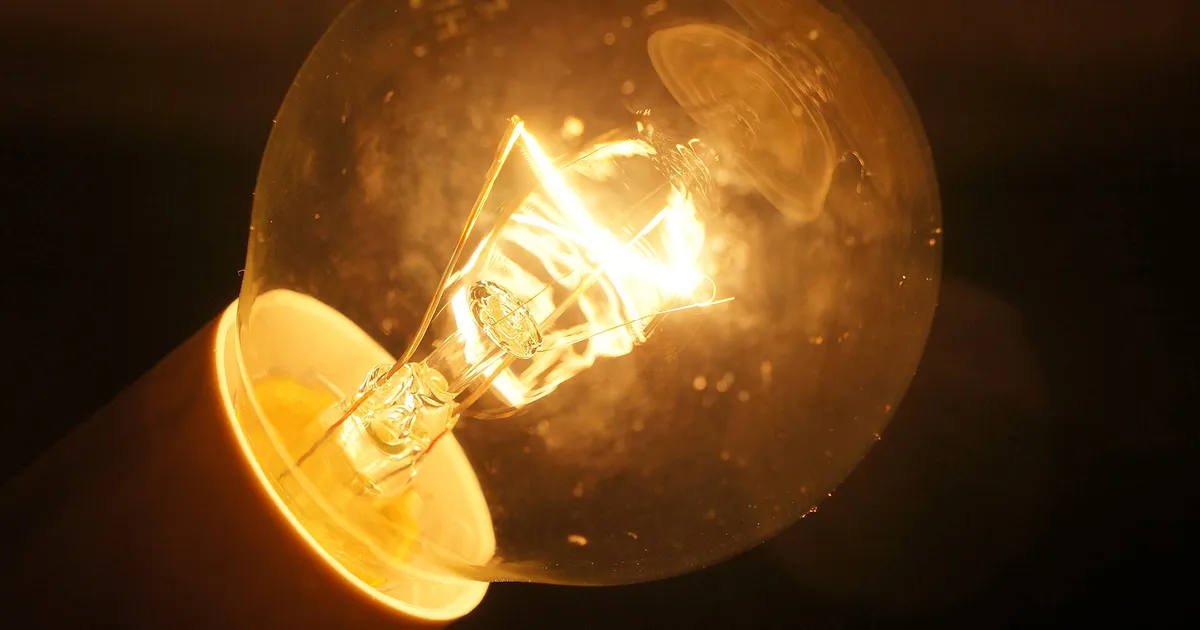
Pure tungsten is the benchmark for heat resistance, but at the extreme end of its range it has weaknesses. At lamp filament temperatures pure tungsten wire sags and breaks as its grains recrystallise and slide. In arc and electron emission uses, pure tungsten releases electrons less easily than some other options. Doping fixes both problems with tiny additions that change the microstructure or the surface chemistry.
This guide explains the main doped grades, where each is used and what a machining shop needs to know before it cuts them. It will help you write a drawing that names the right material and avoid specifying a grade you do not need.
What doping means for tungsten
A dopant is an addition far smaller than an alloying element. Potassium-doped tungsten holds only tens to a few hundred parts per million of potassium bubbles trapped in the metal. Lanthanated tungsten holds around 1 to 2% by weight of lanthanum oxide particles. Neither changes the density of the metal much, which stays close to 19.2 g/cm³, but both change what happens at the grain boundaries or the surface.
Doping is applied during powder processing, before pressing and sintering, and the material is then worked by swaging, drawing or rolling into rod, wire and sheet. As a result most doped tungsten comes as worked stock, and machining starts from rod, plate or wire, not from a pressed block.
The main doped grades
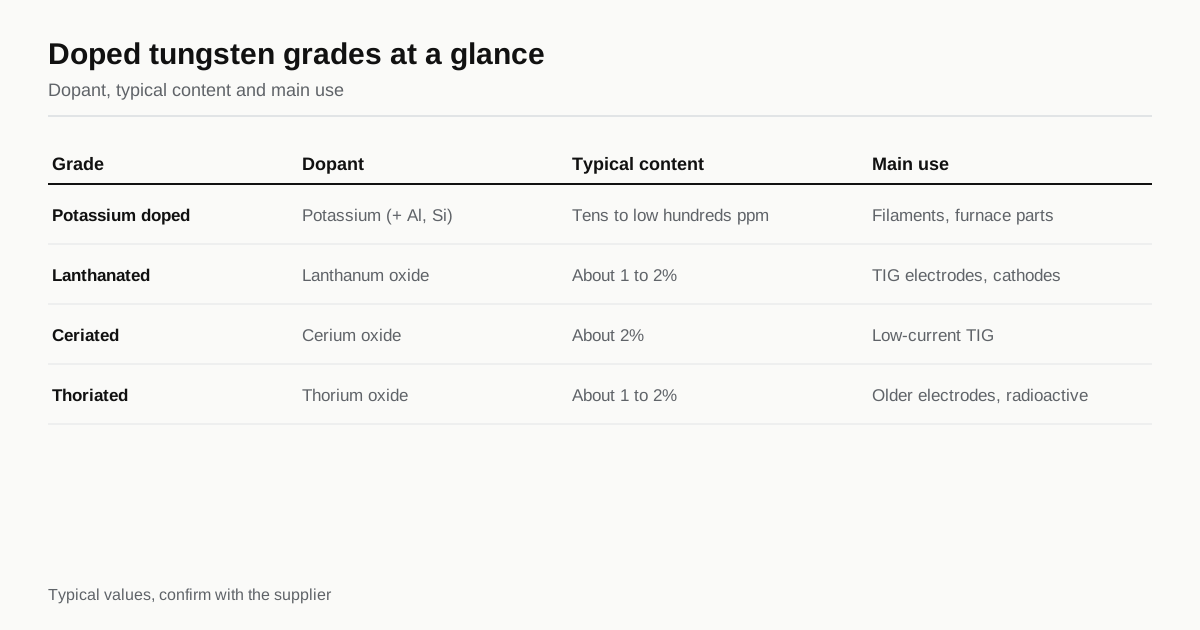
| Grade | Dopant | Typical content | Main use |
|---|---|---|---|
| Potassium doped (often called AKS or non-sag) | Potassium, with traces of aluminum and silicon | Tens to low hundreds of ppm | Lamp filaments, furnace parts, heating elements |
| Lanthanated, 1% | Lanthanum oxide | About 1% | TIG welding electrodes, cathodes |
| Lanthanated, 1.5% | Lanthanum oxide | About 1.5% | General TIG electrodes, wide current range |
| Lanthanated, 2% | Lanthanum oxide | About 2% | TIG electrodes, cathodes |
| Ceriated | Cerium oxide | About 2% | Low-current TIG, small cathodes |
| Thoriated | Thorium oxide | About 1 to 2% | Older electrodes, radioactive, being replaced |
Content figures are typical, and the exact grade names depend on the mill and the standard. For the common electrode grades the lanthanum oxide share is sometimes encoded in the colour or the name, for example WL15 for 1.5%. Always specify by the standard or the supplier’s grade name, not by colour alone.
Potassium doped tungsten
Potassium doping creates the “non-sag” property. During heating, the potassium forms microscopic bubbles along the grain boundaries, which pin the boundaries. The grains grow into long interlocking shapes, often compared to a stack of overlapping bricks, and the wire resists sagging under its own weight at white heat. Without doping, the grains would grow into equiaxed crystals with boundaries that slide.
Where potassium doped tungsten fits.
- Lamp and light source filaments and supports. This is the original application.
- Furnace hot-zone parts. Heating elements, heat shields, supports and fixtures in vacuum and hydrogen furnaces. See machining pure tungsten vacuum furnace components.
- Thin rod and wire parts at high temperature, such as electrodes for high temperature sensors and electron sources.
For machined parts, the key point is that the benefit appears only after the part has been heated through recrystallisation. Before that, the material machines like worked pure tungsten.
Lanthanated tungsten
Lanthanum oxide particles in the tungsten matrix lower the work function, which is the energy needed to release an electron from the surface. This means the electrode strikes an arc easily, runs cooler for a given current and keeps a stable point. Lanthanated electrodes also last longer than pure tungsten electrodes in most arc uses.
Uses include TIG welding electrodes, plasma cutting parts, cathodes in electron beam and discharge devices and some ion source parts. The material is not radioactive, which is the main reason it replaced thoriated grades in many shops. For machined parts, lanthanated tungsten usually starts as rod, and the common operations are cutting to length, grinding a point or a taper and drilling or turning small features. Our guide to tungsten welding electrodes versus machined parts covers the distinction.
Machining doped tungsten
Doped grades machine like pure worked tungsten. The usual cautions apply: sharp carbide tooling, light cuts, rigid setups, filtered coolant and care at exits. The oxide particles in lanthanated rod are small and well dispersed, so they do not noticeably change tool wear. Grinding is the most common operation on doped rod, since points, tapers and fine diameters are ground, not turned. Use a diamond wheel and coolant to keep heat down.
Three details deserve attention.
- Recrystallisation embrittlement. After a part has been heated above its recrystallisation temperature in service, it becomes brittle and can fracture when handled. Do not re-machine used parts, and handle them gently.
- Grinding direction on electrodes. Electrode points are ground along the length of the rod, not across, because lengthwise grinding marks give a stable arc. A shop that makes TIG electrodes knows this, and a general shop may not.
- Dust and fines. Doped tungsten dust is a hazard like any fine metal dust. Shops handle it with wet grinding and extraction. Thoriated material adds a radiological concern, so a shop should know if a rod is thoriated before it cuts or grinds it.
For the broader machining picture, see tungsten CNC machining explained.
Availability, cost and lead time
Doped tungsten costs more than pure tungsten for the same shape, and the premium depends on the dopant, the form and the quantity. The premium is usually small for rod that is made in volume, such as lanthanated electrode stock, and larger for potassium doped sheet and for heavy sections, which only a few mills produce. Lead time follows the same pattern: electrode rod is stocked widely, while special sizes of potassium doped bar may be made to order.
Because stock is worked material, there is no option to buy a pressed block of doped tungsten and cut it to shape in the way you would with heavy alloy. Designs should start from the sizes the mill offers. Check available diameters and thicknesses early, and adjust the design to a standard size if you can. A part that needs a 14 mm diameter from a mill that offers 12 and 16 mm will cost much more than one designed around 16 mm.
Traceability and impurity control
Doped tungsten is often bought for demanding uses, so traceability matters. Ask for a certificate that shows the dopant content or the grade name, the lot number and the density. For parts that go into vacuum systems, semiconductor tools or lamps, impurity limits can matter as much as the dopant itself. Typical items to specify include total metallic impurities, oxygen, carbon and, for some uses, sodium and iron. A shop machining such parts should use clean tooling, avoid cutting fluids that leave residue and clean parts before packing. Say so on the order, because a shop that does not know the application will clean to a general standard. The guide to reading a material certification explains what the numbers on a certificate mean.
A typical electrode job
A small example shows how the pieces fit. A buyer wants 2,000 lanthanated TIG electrodes, 2.4 mm in diameter and 175 mm long, with a ground point. The shop buys 1.5% lanthanated rod at the diameter, cuts it to length by abrasive cutoff or a precision saw, and grinds the tip to a stated angle on a dedicated wheel that has never touched other metals. A dedicated wheel prevents contamination of the tip, which would spoil the arc. The shop marks the end with a colour band or ink according to the standard and packs the electrodes in tubes. The parts are cheap, but the process is specialised, and the shop’s care over the grinding wheel and the marking is what separates a good batch from a poor one. A job like this suits a shop that makes electrodes as a regular line, and it is unusual to find the skill in a general machine shop.
Doped tungsten compared with pure tungsten
The choice between pure and doped is often a matter of life at temperature. A pure tungsten part in a vacuum furnace at 1,800 degrees C may serve well for many cycles, but at higher temperature or in a part that carries its own weight on a span, creep and recrystallisation shorten its life. Doped material extends that life but only if the part is first heated in a way that develops the interlocked grain structure. Discuss the heat history with the mill. In many hot-zone designs the answer is simply pure tungsten for fixtures and shields, and doped tungsten for wire and heating elements.
Choosing a grade
The choice follows the function.
| Need | Suggested direction |
|---|---|
| Part runs near 2,000 °C or higher and must not sag | Potassium doped |
| Arc starting and stability, welding or plasma | Lanthanated or ceriated |
| General high temperature part with no sag concern | Pure tungsten |
| Dense but easy to machine, moderate temperature | Heavy alloy or tungsten copper |
If you are not sure, describe the application and temperature to the shop and ask for a grade recommendation. Do not specify doped tungsten out of caution. It costs more than pure tungsten and has a more limited supply, and it adds no benefit to a part that never reaches the temperature where doping matters.
What to put on the drawing and RFQ
- The grade by name, such as “potassium doped tungsten” or “lanthanated tungsten, 1.5% La2O3”.
- The stock form: rod, wire, plate or sheet, and the diameter or thickness.
- The tolerance and finish on each critical feature, and the application temperature.
- Whether the part will be heated above recrystallisation before or after machining.
- Any limits on impurities if the part goes into a vacuum or semiconductor tool.
When the drawing is ready, send your RFQ. We match it with up to three shops that machine doped tungsten and reply within 24 business hours.
Frequently asked questions
What is doped tungsten?
Doped tungsten is tungsten with a small, controlled addition of another substance, such as potassium in parts per million or a few tenths of a percent of a rare earth oxide such as lanthanum oxide. The dopant changes how the metal behaves at high temperature or how it emits electrons, while the density stays close to pure tungsten.
What is the difference between lanthanated and potassium doped tungsten?
Potassium doped tungsten is used where the metal must resist sagging and creep at very high temperature, as in lamp filaments and furnace parts. Lanthanated tungsten holds about 1 to 2% lanthanum oxide and is used where easy electron emission matters, as in welding electrodes and cathodes.
Is doped tungsten harder to machine than pure tungsten?
It machines in a similar way, as a brittle, hard refractory metal that needs sharp carbide tools, light cuts and good support. The doped structure is more stable at temperature but does not make cutting easier. Used parts that have been heated above recrystallisation become more brittle and should not be re-machined.
Sources
Need a quote for this part?
Send the drawing. We match you with up to 3 shops that cut your tungsten grade and reply within 24 business hours.
Get matched with a tungsten shop