Guides / Materials
Molybdenum Copper or Tungsten Copper: Choosing a Heat Spreader Material
October 24, 2026 · Reviewed October 4, 2026
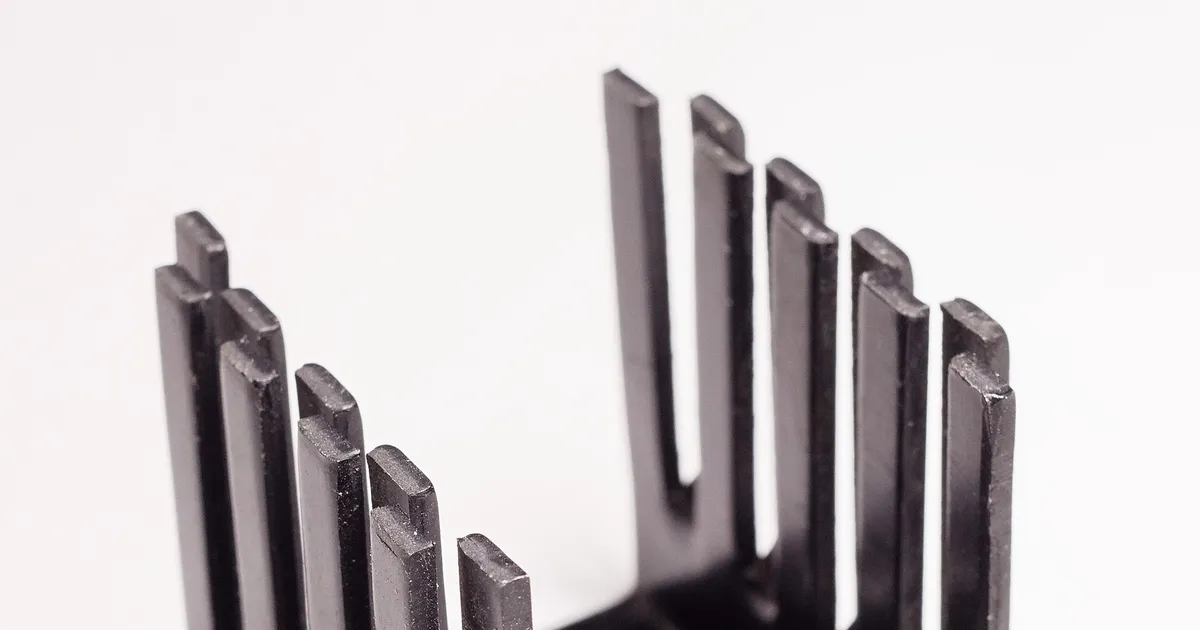
Power transistors, laser diodes, RF amplifiers and high-power LED packages all create heat in a small area. That heat has to spread out before it reaches the heat sink, and the spreader must not stress the semiconductor as it warms. Copper conducts heat very well but expands about three times as much as silicon. Molybdenum copper and tungsten copper split the difference.
This guide compares the two families head to head: weight, conductivity, expansion, hardness, machining, plating and cost. It ends with a decision table and a list of what to put in the RFQ.
What they are
Both are composites of a refractory metal and copper, made by infiltrating copper into a porous skeleton or by pressing and sintering mixed powders. Neither metal alloys with copper, so each material is a mixture of two phases. As with tungsten copper, the grade is named by the weight percentages, so Mo85Cu15 means about 85% molybdenum and 15% copper.
Rolled versions also exist. A common one is a three-layer laminate of copper, molybdenum copper and copper, which gives high conductivity through the thickness and a tailored expansion in the plane. It suits stamped, thin parts at volume and is a separate product family from the infiltrated blocks and plates.
Property comparison
| Property | MoCu (typical) | WCu (typical) |
|---|---|---|
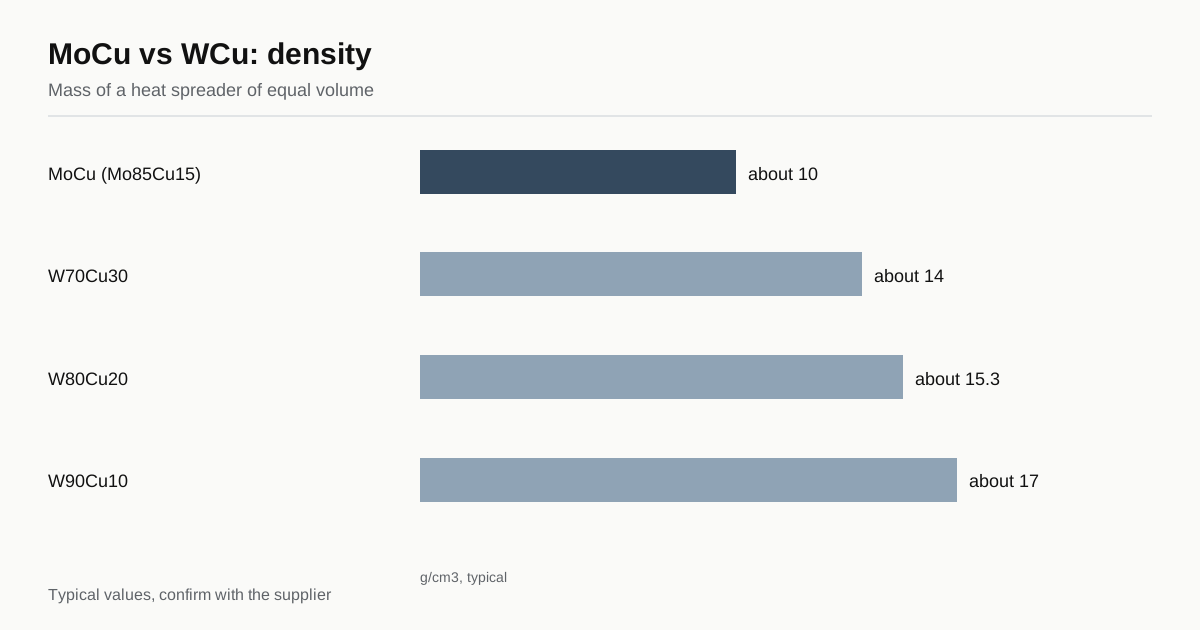
| Density, g/cm³ | About 9.8 to 10.0 | About 14 to 17 |
| Thermal conductivity, W/m·K | About 160 to 200 | About 170 to 250 |
| Thermal expansion, ppm/K | About 6.8 to 9 | About 6.5 to 9 |
| Hardness | Lower | Higher |
| Machinability | Good | Good, harder on tools at high W |
| Relative cost per part | Often lower | Often higher |
| Magnetic | Non-magnetic | Non-magnetic |
All values are typical datasheet ranges at similar copper contents, and they depend on grade and supplier. Compare grades from the same supplier on the same basis, since test methods differ.
Weight
The largest single difference is density. Molybdenum is about 10.2 g/cm³, tungsten is about 19.3 g/cm³, and copper is about 9 g/cm³, so Mo-Cu composites sit near 10 g/cm³ while W-Cu composites run from about 14 to 17 g/cm³ depending on the grade. For a plate of the same volume, Mo-Cu weighs roughly 30 to 40% less. This matters in aircraft, satellite and portable systems where each gram counts.
If weight is not a design driver, the extra mass of tungsten copper may even help, by adding thermal mass that smooths short heat pulses.
Thermal conductivity
Both families reach similar conductivity at similar copper content, since the copper network does most of the heat carrying. Tungsten copper grades with 20 to 30% copper reach 200 to 250 W/m·K, and molybdenum copper grades with 20 to 30% copper reach 170 to 200 W/m·K. The difference of 10 to 20% rarely decides the design alone. What matters is the conductivity measured through the plate thickness in your use, and the quality of the bond to the chip and heat sink. Ask for measured values and the test method.
Expansion match
Expansion mismatch is the reason these materials exist. Silicon expands at about 2.6 ppm/K, gallium arsenide at about 5.7, alumina at about 6.5 to 7 and aluminum nitride at about 4.5. A spreader with expansion between 6 and 8 ppm/K matches most ceramic packages and reduces stress in solder joints under temperature cycling.
Both families can be tuned. More copper raises expansion and conductivity, so the usual rule is to choose the lowest copper content that meets the heat removal need. At equal copper content, tungsten copper tends to have slightly lower expansion than molybdenum copper, and for some very sensitive devices that gap matters. Check the data for the exact grades, and verify with a thermal cycling test on the real assembly when the joint is critical. For tungsten copper grades in more detail, see the guide to W70Cu30 through W90Cu10.
Machining and forming
Tungsten copper machines with carbide tooling, but high tungsten grades are tough on tools. It generally needs machining or EDM for the final shape, as covered in the tungsten copper machining guide.
Molybdenum copper is somewhat easier on tools, and rolled Mo-Cu sheet in thin gauges can be stamped, laser cut and photo-etched. This makes it attractive for volume parts with simple outlines. Thin Mo-Cu parts can also be flatter after cutting than infiltrated blanks. For both materials, burrs and copper smearing need attention, and the machined surface should be clean before plating.
Plating and joining
Most heat spreaders are plated, usually with nickel, often with gold on top, for soldering with gold-tin or similar solder. Both materials plate well when the surface is clean and free of smeared copper, but pores in either can trap plating solutions and cause blisters later. A good shop leaves the surface at a stated finish, commonly Ra 0.4 to 0.8 µm, and cleans parts before plating. If the part is brazed to a ceramic frame, the filler and the temperature profile matter more than the choice between Mo-Cu and W-Cu.
Cost
Molybdenum is cheaper than tungsten per kilogram, and Mo-Cu uses less metal by weight, so Mo-Cu parts often cost less. Rolled and stamped Mo-Cu in volume is cheaper still. Tungsten copper’s cost depends on the grade, and the high-tungsten grades cost the most. Pricing swings with metal markets, so quotes are valid for a short time. If you are comparing, ask for prices of the same shape in both materials, with the same plating and the same tolerance.
Flatness and the joint to the chip
A heat spreader carries heat only as well as its joint to the die. A plate that is bowed by even 20 or 30 micrometres across a package leaves gaps in the solder layer, and those gaps become hot spots. This makes flatness one of the most important numbers on the drawing. Typical requirements for power device spreaders are 0.01 to 0.03 mm over the die area, and tighter for laser diode submounts. Both Mo-Cu and W-Cu can be ground and lapped to these values, though infiltrated blanks may carry some residual stress that shows up as bow after the first cut. Shops typically rough both faces, relieve the stress and grind or lap last. If the application is sensitive, ask the shop to report flatness on a first article and to state the measurement method, because a part that is flat on a vacuum chuck may bow when released.
The surface also needs a controlled finish. A very smooth surface can lower solder wetting, while a rough one traps voids. A finish of Ra 0.4 to 0.8 µm before plating is common, and the plating supplier often has a preferred range.
Rolled laminates and where they fit
For volume parts, a rolled laminate of copper and molybdenum copper layers is a well-known alternative to a solid infiltrated plate. The copper outer layers carry heat quickly through the thickness, and the molybdenum copper core holds the in-plane expansion near that of ceramics. Laminates are made as sheet and stamped or etched into parts, so they suit thin spreaders at low cost per piece. Their weaknesses are lower thermal conductivity in-plane than the through-thickness value suggests, and the presence of layer interfaces that may delaminate under severe thermal cycling if the bonding is poor. For prototypes and small runs, solid infiltrated plates are often easier to obtain, since the laminate needs a minimum order from the roller.
Questions to ask a supplier
- Is the material infiltrated, pressed and sintered or laminated?
- What are the measured density, conductivity and expansion of the lot, and with which test methods?
- What flatness and surface finish can you hold, and how do you measure them?
- Do you plate in-house or through a partner, and what thickness of nickel and gold do you apply?
- What is the minimum order and the lead time for a first article and for repeats?
- Can you provide samples in both materials for a thermal test?
A shop that answers these precisely is a better partner than one that quotes only a price. The small batch machining guide explains how to handle first articles and low volumes.
A short worked comparison
Suppose a 20 by 20 mm spreader, 2 mm thick, must carry a power die and sit between a ceramic substrate and a copper base. In W85Cu15 the plate weighs about 13 g, in Mo85Cu15 about 8 g. Conductivity is similar enough that the chip temperature differs by only a degree or two in a typical case. If the product is an airborne radar module with hundreds of such parts, the 5 g saving per spreader adds up to a kilogram or more and may justify Mo-Cu even if its expansion is a little higher. If the product is a fixed industrial inverter where weight is irrelevant and the lowest expansion gives the best solder life, W-Cu may be the better pick. The right answer comes from the product, not the material alone.
Decision table
| If the priority is | Lean toward |
|---|---|
| Lowest weight | MoCu |
| Lowest expansion at a given conductivity | WCu |
| Hardness and wear resistance | WCu |
| Thin stamped parts in volume | MoCu (rolled or laminate) |
| Highest conductivity | Higher copper grades of either, WCu slightly ahead |
| Radiation absorption in the part | WCu |
| Lowest cost for a simple plate | MoCu in most cases |
If the application sits between two options, request quotes for both and test samples.
What to put on the drawing and RFQ
- The material by name and grade, such as Mo85Cu15 or W80Cu20, or a performance target and a request for advice.
- Flatness, thickness tolerance and surface finish, with the method of measurement.
- Plating specification, thickness and area to be plated.
- Thermal conductivity or expansion targets, with the test method.
- Quantity, repeat order outlook and lead time requirement.
For related materials, see tungsten versus tantalum and molybdenum.
When the drawing is ready, send your RFQ. We match it with up to three shops that machine tungsten copper and related composites and reply within 24 business hours.
Frequently asked questions
What is the main difference between MoCu and WCu?
Molybdenum copper is much lighter, roughly 10 g/cm³ against 14 to 17 g/cm³ for tungsten copper, and it is often cheaper per part. Tungsten copper has slightly lower thermal expansion at the same copper content and is harder and denser. Both match silicon and ceramics far better than pure copper.
Which is better for a lightweight RF or aerospace package?
Molybdenum copper is usually the choice when weight matters, since it is about 35 to 40% lighter than tungsten copper of a similar copper content, with comparable thermal conductivity. Tungsten copper wins when the lowest expansion, highest hardness or radiation absorption is the priority.
Can both be machined and plated the same way?
Both machine with carbide tools and take nickel and gold plating for soldering or brazing. Molybdenum copper is easier to work in thin rolled sheet and can be stamped or laser cut, while tungsten copper usually needs machining or EDM. Surface preparation before plating matters for both.
Sources
Need a quote for this part?
Send the drawing. We match you with up to 3 shops that cut your tungsten grade and reply within 24 business hours.
Get matched with a tungsten shop