Guides / Process
Drilling Pure Tungsten Without Cracks: Tools, Exit Chipping and Hole Limits
October 9, 2026 · Reviewed October 4, 2026
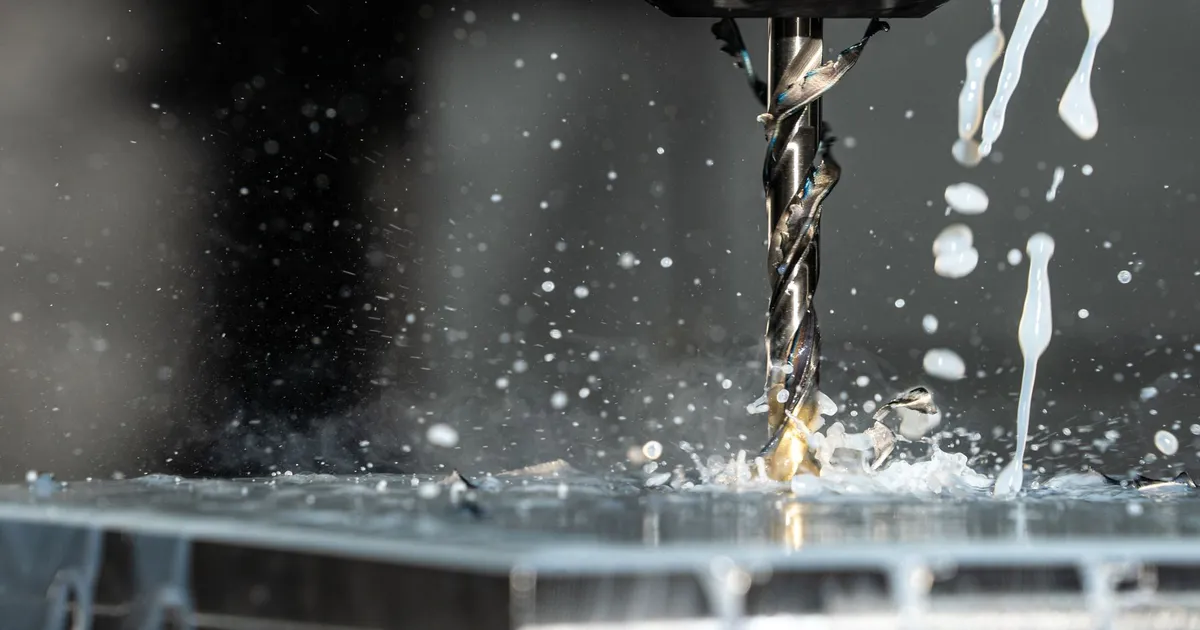
Drilling is where pure tungsten shows its worst side. A hole looks like a simple feature, but it concentrates stress at the drill tip, traps heat at the bottom and leaves a thin brittle skin at the exit. A drill that works well in steel can chip, crack or break in tungsten within seconds.
This guide explains why pure tungsten behaves this way, how experienced shops drill it, what limits to expect for depth and diameter, and when to specify EDM instead. It applies to pure tungsten and to the sintered grades of tungsten. Heavy alloy drills much more like cast iron and is covered elsewhere.
Why pure tungsten cracks when drilled
Pure tungsten has the highest melting point of any metal and a very high hardness for a metal. It also has a ductile-to-brittle transition above room temperature, so at shop temperature it fractures rather than flows. A cutting edge in steel shears a continuous chip. In tungsten the same edge starts a crack ahead of the cut, and the chip breaks away in small fragments.
Three features of a drilled hole make this worse.
- The chisel edge at the centre of the drill does not cut, it pushes. That thrust loads the brittle material in tension.
- The bottom of the hole is a confined space. Heat and fines build up there.
- The exit leaves a thin web. As the drill breaks through, the remaining layer is too thin to resist the thrust and it breaks outward.
Material condition matters as well. Stress-relieved, worked tungsten (rolled, swaged or forged) cuts more cleanly than a coarse as-sintered blank, which can hide porosity and grain boundary weakness. If a hole will sit close to an edge, tell the shop how the blank was made. The sintered versus wrought blanks guide explains the difference.
Tools and settings shops use
The approach is the same across most shops that drill tungsten regularly, though details vary.
| Parameter | Typical practice | Reason |
|---|---|---|
| Drill material | Solid micro-grain carbide | Holds an edge against tungsten hardness |
| Point geometry | Split point or thinned web, 118 to 140 degrees | Cuts a smaller chisel edge, lowers thrust |
| Coolant | Flood or through-tool, filtered | Removes heat and fines from the hole bottom |
| Feed | Low and constant, reduced at breakthrough | Prevents exit chipping |
| Cycle | Peck, with full retract on deeper holes | Clears fines, limits heat build-up |
| Machine | Rigid, low runout, no spindle wobble | Runout snaps small carbide drills |
Spindle speed is kept moderate. High speed raises heat at the tip and tungsten does not tolerate thermal shock well. Exact figures depend on the drill diameter, the machine and the grade, and a shop will often run a test hole on scrap before committing to the real part.
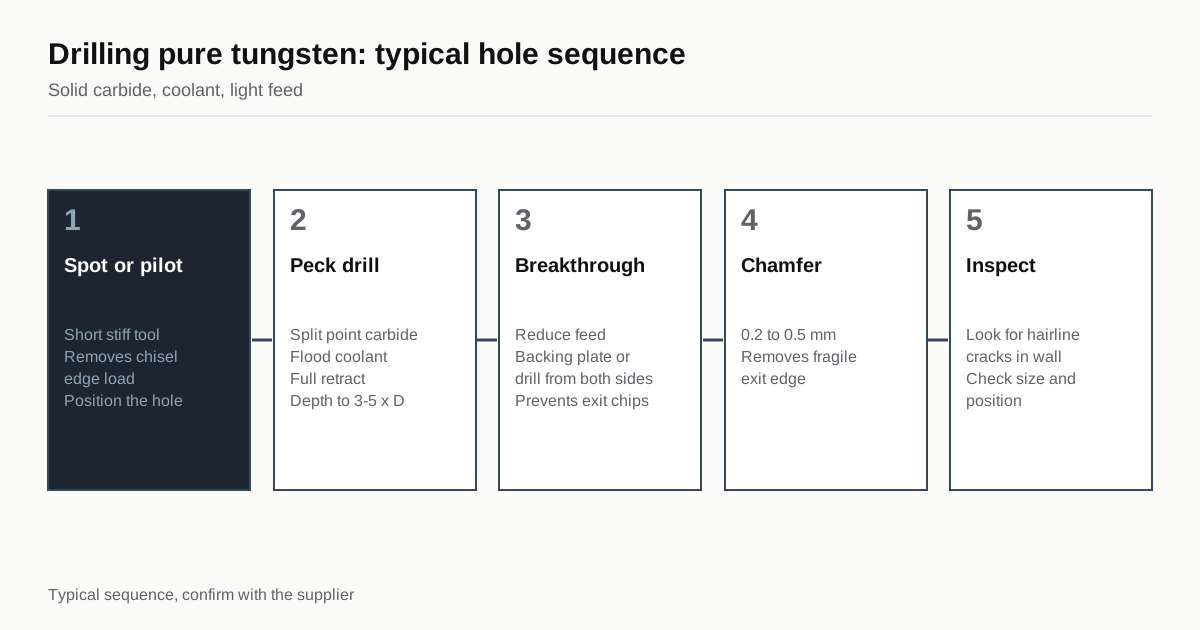
A pilot drill helps on larger diameters. A small pilot hole removes the chisel edge loading, and the larger drill then cuts mostly with its lips. Some shops also pre-spot the position with a short, stiff centre drill so the main drill does not walk.
Controlling exit chipping
The cheapest improvement is to back up the exit. Clamping a sacrificial plate of steel, graphite or ceramic-filled material behind the part gives the drill something to break into. Another approach is to drill from one side to about two thirds of the thickness and then drill from the other side to meet it. This leaves a small step in the middle but avoids a ragged exit on a visible face.
Reducing the feed in the last 0.5 mm before breakthrough also helps. On a CNC machine this is a simple program change. A sharp drill matters here because a worn edge pushes harder than it cuts.
Allow for a small chamfer on the exit when the design permits. A 0.2 to 0.5 mm chamfer removes the most fragile edge and gives a clean finish to what remains. If the drawing shows a sharp edge and the shop sees chipping risk, expect a question about it.
How deep and how small
Practical limits for drilled holes in pure tungsten are different from steel.
| Hole feature | Typical limit | Alternative if beyond |
|---|---|---|
| Depth to diameter, peck drilling | Up to about 3 to 5 times diameter | EDM hole drilling |
| Smallest drilled diameter | Around 0.5 to 1 mm, and risky | EDM or laser drilling |
| Position tolerance | ±0.05 mm typical | Jig grinding or EDM for tighter |
| Diameter tolerance as drilled | About ±0.05 mm | Reaming or EDM |
| Surface of drilled hole | Rough, with some micro-chipping | Honing, lapping or EDM |
These are typical figures, and they depend on the grade, the machine and the drill. For deeper or finer holes the shop will usually suggest EDM drilling. EDM removes material with spark erosion, so it applies no cutting force and does not care about brittleness. It is slower and leaves a thin recast layer, and a shop may remove that layer if the hole is functional. For the wire version of the process, see wire EDM for tungsten parts.
When EDM is the better first choice
Choose EDM drilling when any of these apply.
- The hole is smaller than about 1 mm in diameter.
- The depth exceeds five times the diameter.
- The hole sits near an edge or between thin walls.
- The hole must be burr-free and exit-chip-free on a visible face.
- The part is expensive and a drill break would scrap it.
For through holes in thin tungsten plate the choice often comes down to risk. One broken drill in a finished blank costs more than the extra time for EDM. If a hole is not critical, a shop may still drill it conventionally and accept some risk. State on the RFQ which holes are critical so the shop can plan around them.
A typical process route for a drilled hole
A well-run job follows a repeatable sequence, and knowing it helps you read a quote. The shop first confirms the blank: its density, its surface and whether it shows cracks or porosity under a dye penetrant or a visual check. It then sets up the part with soft, even clamping so the clamp itself does not load the brittle material. Next comes the spot or pilot operation, then the main drill with peck cycles, and finally any chamfer, ream or deburr. Between these steps a careful shop inspects the hole under magnification for hairline cracks radiating from the wall. A crack found at this stage costs the price of one part. A crack found after the part is installed in a furnace or vacuum chamber costs far more.
If the quote shows an unusually low price for a hole-heavy tungsten part, ask how many drills the shop expects to use. Carbide drills in this material are consumables, and a shop that plans for two or three per part will price accordingly. A shop that plans for none is probably either very experienced or not thinking about the risk.
Heat, fines and safety
Drilling tungsten produces hard, abrasive fines that wear the drill flutes, the chuck and the machine ways. Flood coolant with good filtration protects both the drill and the machine. Dry drilling is a poor idea, partly for heat and partly because fine tungsten dust is a respiratory hazard that shops manage with wet processing and extraction. Used coolant and swarf from tungsten are usually collected and sold or recycled because the material has real scrap value, and a good shop keeps swarf separate from other metals for that reason.
Doped and alloyed tungsten
Not all pure tungsten drills the same. Doped grades used for lamp and furnace parts have a different grain structure, and tungsten-rhenium alloy is notably more ductile and drills with less chipping, though it costs far more. Tungsten copper and tungsten heavy alloy drill far more like hard brass and cast iron, so the cautions in this guide apply less. If your design has a choice of grade and the hole is the hard part, a short conversation with the shop about an alternative grade can save money. The guide to what each grade allows compares the options.
Threads in tungsten
Tapping pure tungsten is rarely a good idea. A tap cuts with many edges at once and the thread root is a stress concentrator in a brittle material. Thread milling with a carbide cutter gives better results, and many designers avoid threads in pure tungsten entirely and use a threaded heavy alloy or steel insert, or a clamp, in their place. If the application needs a thread, discuss the grade. Tungsten heavy alloy takes threads far more easily. The threading and tapping guide covers the options.
What to put on the drawing
- Mark which holes are critical and give the tolerance on each.
- State the exit condition: chamfer size or “sharp edge acceptable with minor chipping”.
- Give the depth and diameter so the shop can see the ratio.
- Specify the surface finish inside the hole only if it matters.
- Name the process if you have a preference, for example “EDM drilled”.
- State the blank type, sintered or wrought, if you know it.
Leaving a hole feature on a pure tungsten drawing without any of this information invites a quote that assumes the cheapest process and a later argument about quality. The shop would rather ask than guess. The drawing mistakes guide lists other common omissions.
Checklist before you request a quote
- List every hole with diameter, depth and tolerance.
- Mark the critical holes and say what failure looks like.
- Say whether the grade is pure tungsten, doped tungsten or another material.
- Give the quantity, since EDM setup cost spreads better over a batch.
- Send a STEP file along with the dimensioned drawing.
Holes sit inside the wider decision path in our guide on how to machine tungsten.
When the drawing is ready, send your RFQ. We match it with up to three shops that machine pure tungsten and reply within 24 business hours.
Frequently asked questions
Can you drill pure tungsten with a normal drill?
Not with a high-speed steel drill. Pure tungsten is hard and brittle, so shops use solid carbide drills with a sharp, well-supported point, low feed, coolant and peck cycles. Even then the hole exit chips unless the part is backed up. Small, deep or tightly positioned holes are often made by EDM instead.
How deep can you drill a hole in pure tungsten?
With solid carbide and pecking, depths of about three to five times the diameter are realistic for drilled holes. Beyond that, drift, heat and drill breakage rise quickly. Deeper holes are normally made by EDM drilling or by drilling from both sides, and the shop will say which suits your drawing.
Why does pure tungsten chip at the hole exit?
The drill pushes the last thin layer of material outward before it shears, and brittle tungsten breaks away instead of bending. Backing the exit with a sacrificial plate, reducing feed as the drill breaks through and using a sharp drill all reduce the chip. A small chamfer allowance on the drawing helps too.
Sources
Need a quote for this part?
Send the drawing. We match you with up to 3 shops that cut your tungsten grade and reply within 24 business hours.
Get matched with a tungsten shop