Guides / Process
Grinding Tungsten Heavy Alloy: Which Wheel, What Finish, How Tight
October 13, 2026 · Reviewed October 4, 2026
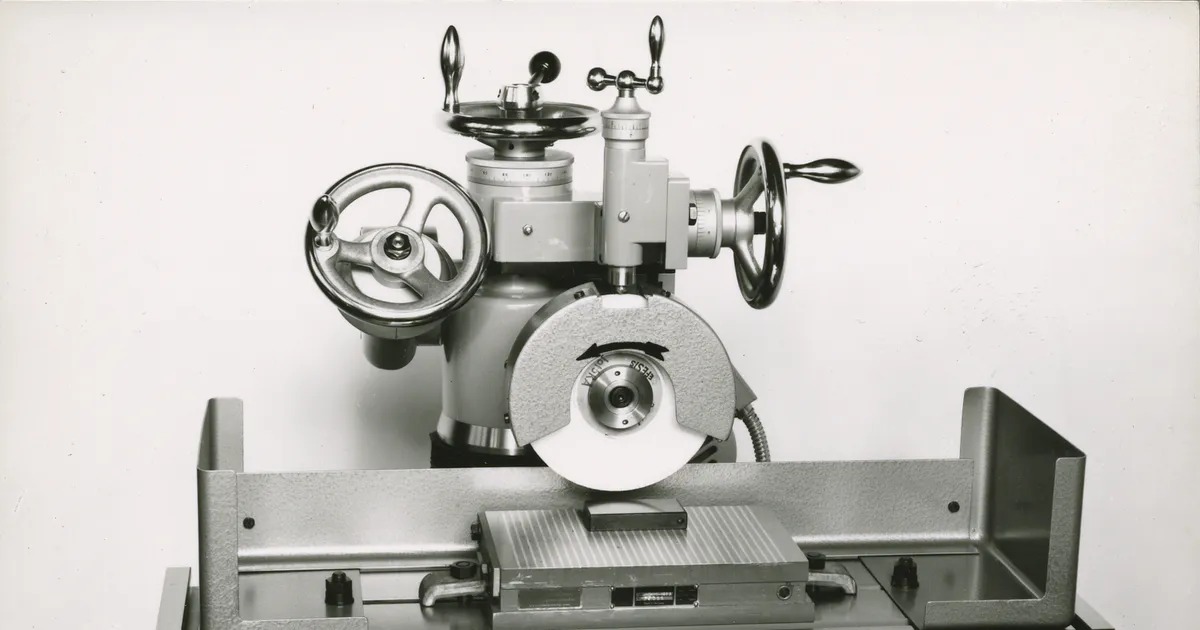
Grinding is the finishing step that gets tungsten heavy alloy to its tightest flatness, parallelism and surface finish. Turning and milling leave a good surface on this material, but they rarely give you the flat faces and fine tolerances that shielding blocks, counterweights and fixture parts sometimes need. If your drawing calls for a ground face, a few details decide whether the part comes back right the first time.
This guide covers wheel choice, coolant, feeds, workholding and the finish and flatness you can reasonably expect. It also covers what to write on the drawing so the shop quotes the grinding you actually need.
Why heavy alloy grinds differently from steel
Tungsten heavy alloy is a composite. Hard tungsten grains, typically 90 to 97% of the weight, sit in a softer nickel-iron or nickel-copper binder. A grinding wheel meets both phases at once. The tungsten grains resist cutting and wear the abrasive, while the softer binder smears and can load the wheel face with metal.
Two problems follow from this. The wheel dulls faster than it does on tool steel, and a dull wheel generates heat. Heat at the cut can microcrack the surface of the tungsten grains and leave a smeared binder layer that looks smooth but is not clean. Good grinding practice on this material is mostly about keeping the wheel sharp, keeping the cut cool and taking light passes.
Choosing the wheel
There is no single correct wheel, and shops develop their own preferences. The broad options look like this.
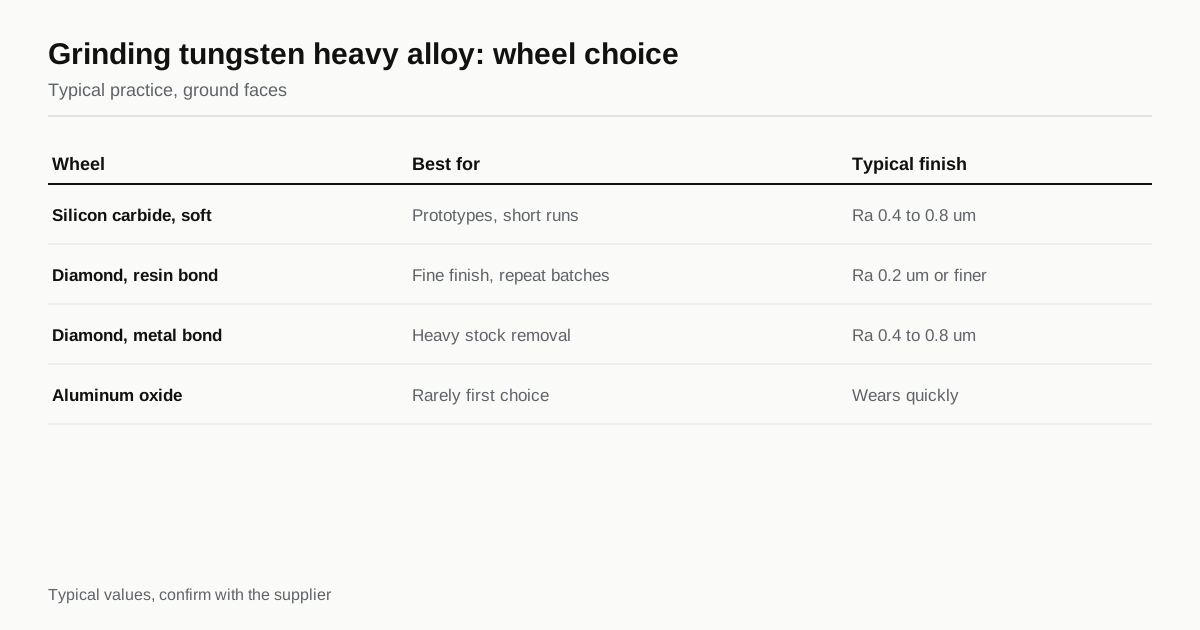
| Wheel type | Typical use | Notes |
|---|---|---|
| Silicon carbide (green), soft grade | General flat and cylindrical grinding | Cheap, open structure, sheds binder smear when dressed often |
| Aluminum oxide | Rarely first choice | Wears quickly against tungsten grains |
| Diamond, resin bond | Fine finish, tight flatness, longer batches | Higher wheel cost, lower cost per part on repeat work |
| Diamond, metal bond | Heavy stock removal on hard grades | Needs good coolant and a stiff machine |
For prototypes and short runs, silicon carbide wheels keep the cost down. For repeat orders or any part where the finish is critical, a diamond wheel usually pays for itself because it holds its form and cuts cooler. Ask the shop what they run and why. A shop that grinds tungsten regularly will answer in specifics, such as grit size and how often they dress the wheel.
Feeds, coolant and dressing
Light infeed is the rule. Roughing passes of around 0.01 to 0.02 mm per pass on a surface grinder are common, dropping to 0.002 to 0.005 mm for finishing passes, followed by a spark-out pass with no additional infeed. These are starting figures only. The real values depend on the wheel, the machine stiffness and the binder.
Coolant is not optional. Flood coolant carries heat away from the cut and washes loose binder out of the wheel face. A water-soluble coolant with a good concentration works well. Dry grinding of tungsten is a poor idea for two reasons: the heat damages the surface, and the fine dust is a health concern that shops control with wet processing and extraction.
Dress the wheel often. A glazed wheel is the most common cause of burn marks and poor finish on heavy alloy. Many shops dress before each finishing pass on a critical face. If a part comes back with dull, smeared faces, wheel condition is the first thing to check.
Workholding: magnetic or not
Nickel-iron binder grades (W-Ni-Fe) are magnetic enough to hold on a standard magnetic chuck, although the pull is weaker than on steel because the tungsten phase is not magnetic. Nickel-copper grades (W-Ni-Cu) are essentially non-magnetic, so a magnetic chuck will not hold them. Those parts need a vacuum chuck, a fixture or clamping, and clamping adds setup time and a risk of distortion on thin parts.
This is one of the details that changes a quote. If your part must be non-magnetic for the application, tell the shop up front, because it drives both the material choice and the grinding setup. For more on why some applications need the non-magnetic grade, see non-magnetic tungsten parts.
What finish and flatness to expect
| Feature | Typical ground result | Comment |
|---|---|---|
| Surface finish, ordinary wheel | Ra 0.4 to 0.8 µm | Fine for most shielding and weight parts |
| Surface finish, diamond wheel | Ra 0.2 µm or finer | Needs spark-out and clean coolant |
| Flatness, small parts | 0.005 to 0.01 mm | Depends on part size and thickness |
| Parallelism | 0.005 to 0.01 mm | Tighter is possible on small, thick parts |
| Size tolerance | ±0.005 to ±0.01 mm | ±0.002 mm needs temperature control |
These are typical values, and a particular shop and machine may do better or worse. Pay attention to the last row. Tungsten heavy alloy expands at roughly half the rate of steel, which helps, but a part still grows measurably if it is warm from the cut, so shops measure after the part cools.
Grinding versus turning and milling
Machining heavy alloy with carbide tooling is routine, and turned or milled faces often meet a tolerance of ±0.02 mm with a finish near Ra 0.8 to 1.6 µm. That is enough for many parts. Grinding adds cost, because it is another setup and often another operation on another machine, so only call it out where the function needs it.
Faces that usually justify grinding include sealing and mounting faces on shielding assemblies, the datum faces of fixtures and gauges, bearing and sliding surfaces, and any face that must be flat to within a few hundredths of a millimetre over a long span. Faces that rarely justify it include free surfaces, internal pockets and cosmetic faces. For the wider range of tolerances shops hold, see tungsten machining tolerances and finish.
Cylindrical and centreless grinding
Round parts follow the same rules with different machines. Cylindrical grinding between centres gives the best roundness and size control on shafts and pins. Centreless grinding suits long runs of simple cylinders, such as small weights and rods, where the shop wants a consistent diameter at a low cost per part. Both need the same attention to coolant and wheel dressing. A tolerance of ±0.005 mm on diameter is practical on small rods, and tighter figures need a clear conversation with the shop about the measuring method.
Grinding after sintering versus after machining
Some buyers ask whether to grind a sintered blank before or after other operations. The usual order is rough machining first, grinding last. Sintered or swaged stock has a hard, slightly rough skin, and the first pass removes it. Leave grinding allowance on the faces that need it, commonly 0.1 to 0.3 mm, so the final grind cleans up any distortion left from earlier cuts. If you are not sure how much to leave, let the shop set it. Parts ground to size on a first pass with no allowance leave no margin for correction.
Inspection: how the shop proves the ground face
A ground face is only as good as the check that confirms it. Flatness and parallelism on small parts are normally checked on a granite surface plate with a dial or electronic indicator, or on a coordinate measuring machine for more complex parts. Surface finish is read with a stylus profilometer. Ask the shop to report the actual figures on the faces you flagged, and to say how many parts they measured. A first-article report on a new part is reasonable to request and usually costs little compared with the cost of finding a flatness problem after assembly.
One practical point is temperature. Tungsten heavy alloy is dense and conducts heat moderately well, so a part that just left the grinder is warm and measures slightly large. Shops that work to a few micrometres let the part soak to room temperature before the final measurement, and the same applies to your incoming inspection. If your incoming check is done in a warm area, it may disagree with the shop’s number for no reason connected to the part.
Cost drivers specific to grinding
Grinding time is not proportional to part size. It is set mostly by setup, by the number of faces and by the stock to remove. A single flat face on a small block adds little. Six faces to a flatness of 0.005 mm each, with inspection between passes, can double the price of a simple part. The wheel is also a consumable, and diamond wheels have a high purchase cost that the shop spreads over a batch, so a one-off part carries more of that cost than a batch of fifty. If your quantity is flexible, ask for a price at two quantities to see where the break falls. The small batch guide explains how quantity changes the quote.
Common drawing mistakes with ground faces
- Calling grinding on every face. It raises the price without helping function.
- No finish callout on the ground faces. The shop guesses, and the inspection is then a dispute.
- Flatness stated without a measurement method. Say whether it is checked on a granite plate with an indicator or on a CMM.
- Non-magnetic requirement missing. The shop quotes a magnetic chuck setup and then has to change it.
- Sharp internal corners on ground faces. A wheel cannot reach them, so allow a relief groove or radius.
The drawing mistakes guide covers more of these.
Checklist before you request a quote
- State the grade, including binder type, so the shop knows if the part is magnetic.
- List which faces need grinding and give the finish and flatness for each.
- State the quantity, since wheel choice and fixturing depend on batch size.
- Give the measurement method for tight tolerances.
- Send a STEP file and a dimensioned drawing.
Grinding is one finishing route in our guide on how to machine tungsten.
When the drawing is ready, send your RFQ. We match it with up to three shops that grind tungsten heavy alloy and reply within 24 business hours.
Frequently asked questions
What grinding wheel is best for tungsten heavy alloy?
Most shops use a soft-grade silicon carbide wheel for general work and a resin or metal bond diamond wheel when they need the best finish or run long batches. The deciding factor is how much stock comes off and how many parts share the setup. Ask the shop which wheel they run, because the right answer depends on their machine.
Can I hold tungsten heavy alloy on a magnetic chuck?
Only the nickel-iron (W-Ni-Fe) grades are magnetic enough to hold well. Nickel-copper (W-Ni-Cu) grades are essentially non-magnetic, so they need vacuum, fixtures or clamping. State the binder on the RFQ so the shop plans the workholding before quoting.
What surface finish can ground tungsten heavy alloy reach?
Typical ground finishes sit around Ra 0.4 to 0.8 micrometres with ordinary wheels and can reach Ra 0.2 or finer with a diamond wheel and a spark-out pass. Ask for the finish only on faces that need it, since every extra grinding pass adds cost.
Sources
Need a quote for this part?
Send the drawing. We match you with up to 3 shops that cut your tungsten grade and reply within 24 business hours.
Get matched with a tungsten shop