Guides / Process
Thin Tungsten Plate and Foil: How Shops Machine It Without Cracks or Warp
October 17, 2026 · Reviewed October 4, 2026
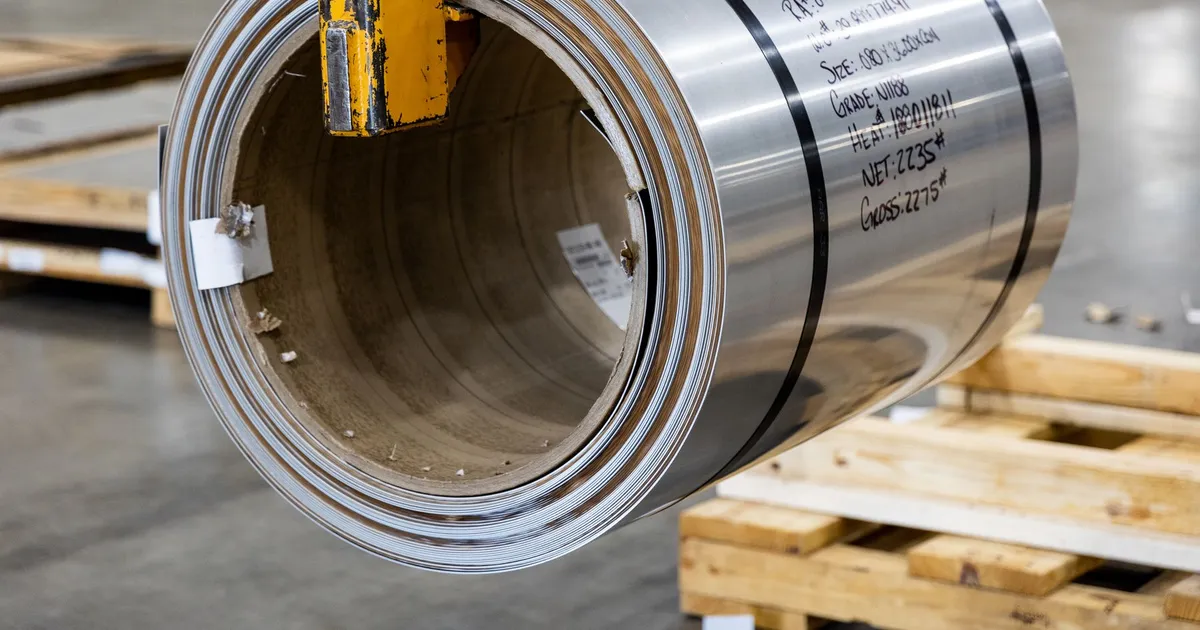
Thin tungsten plate and foil show up in X-ray equipment, vacuum furnaces, ion beam apertures, heat shields and electronic packaging. The material is attractive because it holds its shape at temperatures where other metals soften. But thin tungsten is a hard, brittle material in a form that has almost no stiffness to spare, and the usual shop methods can crack it or bend it.
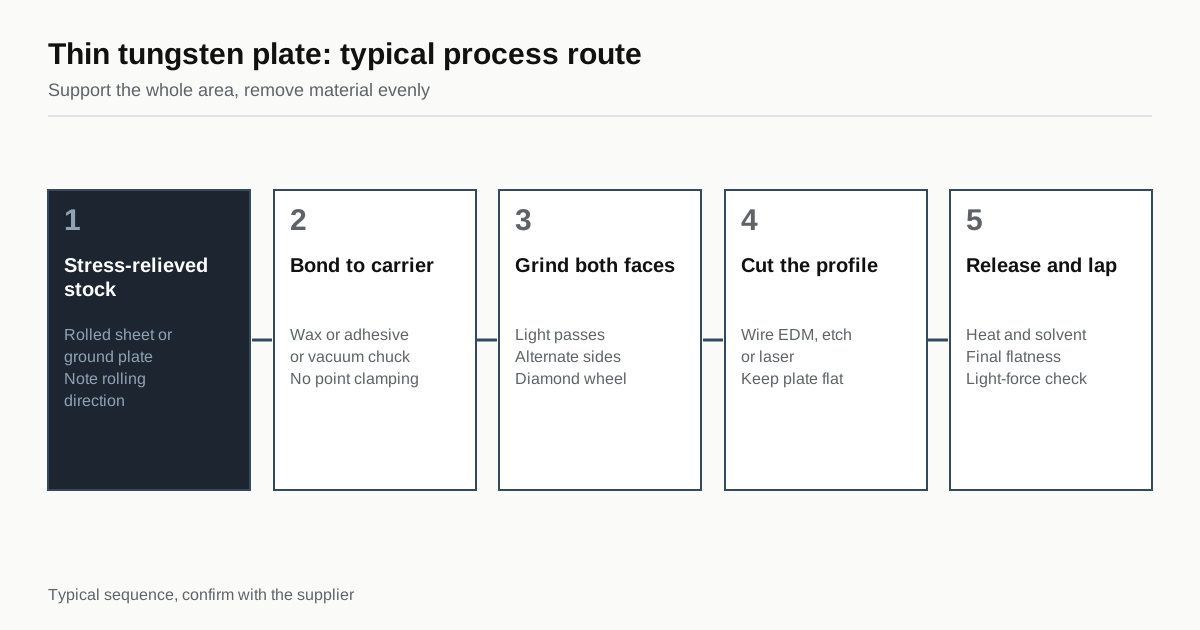
This guide covers how experienced shops handle thin tungsten: what they mean by plate, sheet and foil, how they hold it, how they remove material, how they control warp and what you can do on the drawing to make the job easier.
Plate, sheet and foil
Terms vary between mills, but a rough guide helps you ask for the right thing.
| Form | Typical thickness | Typical process | Notes |
|---|---|---|---|
| Plate | Over about 1 mm | Sintered then rolled or forged, then ground | Machinable by milling and grinding |
| Sheet | About 0.1 to 1 mm | Rolled from plate, stress relieved | Cut by EDM, waterjet, laser; ground flat |
| Foil | Under about 0.1 mm | Rolled thin, often annealed | Cut by etching, laser or fine stamping |
Mills differ in what they can supply, and not every mill makes foil. The thinner the product, the fewer sources exist and the longer the lead time.
Why thin tungsten is difficult
Four characteristics combine.
- Brittleness at room temperature. Tungsten fractures rather than bends when stressed below its ductile-to-brittle transition. For worked sheet that temperature sits well above room temperature.
- Rolling texture. Rolled sheet has elongated grains. It can split or delaminate along the rolling direction when it is cut, drilled or bent against the grain.
- Residual stress. Rolling and grinding both leave stress in the plate. When the shop removes material, the stress rebalances and the plate bows.
- Low stiffness in thickness. A thin plate flexes under clamp pressure, cutting force and even its own weight, so the part can measure flat while clamped and curve when released.
Workholding
Most scrap on thin tungsten comes from clamping. Mechanical clamps that bite at the edge concentrate stress and start cracks. Better options are these.
- Vacuum chucks. They hold the plate over its whole area with even pressure. They work well on flat sheet but need a good seal, so they do not suit parts with many through holes unless a backing sheet is used.
- Wax or adhesive mounting. The shop bonds the plate to a flat carrier plate with wax or thermal adhesive, machines it and then releases it with heat and solvent. This supports the plate over its whole area and is a standard way to grind and lap thin pieces.
- Sacrificial backing. A plate of steel or aluminum under the tungsten supports it during cutting and catches the breakthrough.
- Soft jaws and light clamps. For thicker plate, soft jaws with gentle pressure avoid point loads.
Magnetic chucks do not hold pure tungsten, so grinding thin pure tungsten needs vacuum or bonded mounting. Heavy alloy in the nickel-iron grades is slightly magnetic, as explained in the guide to non-magnetic tungsten.
Removing material
Several routes exist, each with trade-offs.
Grinding. Surface grinding with a diamond wheel brings plate to thickness and flatness. Passes are light, coolant is generous and the wheel is dressed often. Typical thickness tolerance on a sheet of 0.5 mm is ±0.01 mm, and ±0.005 mm is possible on small parts with care. Double-disc grinding handles larger volumes of flat parts, and lapping reaches finer flatness and finish.
Wire EDM. Cuts profiles with no force and no heat damage to speak of, so it suits thin plate with intricate outlines. Keep the plate clamped flat between cuts. See wire EDM for tungsten parts and the comparison of cutting methods for sheet.
Chemical etching and laser. For foil, photochemical etching and laser cutting make fine features at low cost and with little force. Etching leaves a slight edge taper and laser leaves a heat-affected edge, so choose according to the application.
Milling. Possible on plate over a millimetre thick with sharp carbide tools, light cuts and fully supported workholding. Thin sheet is rarely milled because the cutting force bends or cracks it.
Controlling warp
Warp is the second biggest cause of rejects after cracks. Several habits keep it down.
- Start with stress-relieved plate, and tell the shop if you need that.
- Remove material evenly from both faces, alternating sides, so the stress state stays balanced.
- Rough, relieve and finish in sequence for thick parts that need tight flatness.
- Avoid cutting a large pocket or slot on one side only.
- Flatten at the end by lapping or a final light grind, with the plate supported on a flat bonded carrier.
Typical flatness on well-made thin plate is 0.02 to 0.05 mm over 50 mm, and tighter values are possible with lapping at extra cost. A flatness figure should always come with a measurement method and a size, since flatness over a 10 mm part and over a 100 mm part are different tasks.
Bending and forming
Thin tungsten can be formed, but only when it is warm. Shops heat the sheet to a temperature above the transition, usually a few hundred degrees C and set by the mill for the specific product, bend it in a hot fixture and cool it slowly. Bend radius should be generous, and the bend line should run across the rolling direction, not along it. If your design needs a formed tab or fold, discuss it before you finalize the drawing. In many cases a better design avoids the bend by machining a thicker plate to shape or joining two flat pieces.
What to put on the drawing
- Thickness and thickness tolerance, with the measuring position for tapered plate.
- Flatness, with a size and a method.
- Edge condition for cut profiles: chips allowed, burr limits, recast layer.
- Hole sizes and positions, with notes about edge distance and any breakthrough requirements.
- The rolling direction if it matters to the application.
- The grade: pure, doped or alloyed, and the condition of the stock.
Leaving out the rolling direction on a part with long slots is a classic cause of splits. The drawing mistakes guide covers other omissions.
Inspection of thin parts
Measuring a thin tungsten part is as delicate as making it. A contact micrometer can dent soft foil or crack a brittle edge, so shops use light-force or non-contact methods on the thinnest material, such as an optical comparator, a laser micrometer or a vision system. Thickness is checked at several points, since a ground plate can taper by a few micrometres across its width. Flatness is measured with the part resting free on a granite plate, with an optical flat or on a coordinate machine that touches the part lightly. A part that is flat when held down by vacuum and bowed when free is a common source of disagreement between supplier and buyer, so write down which condition applies. Ask for a first-article report on the first parts of a new design.
Handling, cleaning and packaging
Thin tungsten parts need care after machining as well. Handle them with clean, soft-tipped tools or gloves and never pinch them at an edge. Ultrasonic cleaning in a mild detergent or solvent removes grinding fines and etchant residue, and a vacuum-compatible application may need a specific cleaning and drying procedure that you should state on the order. Pack parts flat between clean, non-abrasive interleaving sheets in a rigid box, with foam on both sides so the box cannot flex in transit. A foil that arrives creased or with chipped edges often suffered in the post, not in the shop, so good packing protects both sides. The same care applies at your own incoming inspection and assembly.
Cost and lead time
Thin tungsten is not cheap. The raw sheet carries a premium over thick plate because of rolling cost and yield loss, and the machining takes more time because of light passes, careful setups and a higher reject allowance. A shop may quote a scrap rate into the price for the thinnest or most intricate parts, and for a small run that is reasonable. Lead time depends mostly on stock. If the mill holds the thickness you need, the shop can start within days. If the sheet is made to order, add several weeks. You can cut both cost and lead time by choosing a standard thickness from the mill’s list instead of a custom one, and by allowing a thickness tolerance that matches the application. For how quantity changes the quote, see small batch tungsten machining.
Choosing another material
If the plate does not need pure tungsten’s full temperature capability, consider heavy alloy sheet or tungsten copper, which are far more forgiving to cut and form. For some heat shield and reflector uses, molybdenum is easier to work and costs less. The tungsten versus tantalum and molybdenum guide compares them.
Checklist before you request a quote
- State thickness, size, quantity and grade.
- Give flatness and thickness tolerance with a measurement method.
- List edge and hole requirements.
- Say whether any bending is needed.
- Send a STEP or DXF file with a dimensioned drawing.
When the drawing is ready, send your RFQ. We match it with up to three shops that handle thin tungsten and reply within 24 business hours.
Frequently asked questions
How thin can tungsten be machined?
Shops grind and cut tungsten plate down to about 0.1 mm routinely and thinner foil is made by rolling, with final shaping by etching or laser. Below about 0.5 mm the risks of cracking and warp rise sharply, so expect higher price and looser flatness than on thick plate.
Why does thin tungsten plate crack?
Tungsten is brittle at room temperature, and a thin section has little room to absorb clamping force, cutting force or thermal shock. Rolled sheet can also split along its rolling direction. Careful workholding, light cuts and low-heat cutting methods keep the plate intact.
Can thin tungsten plate be bent?
Only with heat. Tungsten bends without cracking above its ductile-to-brittle transition, which for worked sheet is typically a few hundred degrees C, and shops form it warm. Bending cold usually cracks it. If the part needs a bend, say so on the drawing so the shop can plan the forming.
Sources
Need a quote for this part?
Send the drawing. We match you with up to 3 shops that cut your tungsten grade and reply within 24 business hours.
Get matched with a tungsten shop